
AI job salary in Singapore 2026: What AI skills really pay


Table of Contents
💡 Key takeaways
- AI job salaries in Singapore sit well above the national average, and they’re rising far faster than typical pay.
- You don’t need to be an engineer to benefit, because most demand is for people who can use AI in everyday work.
- Regional tech and financial services pay the most, with top packages above S$280,000 a year.
- Use these benchmarks to value your own pay or target your next move.
- Short, practical training aimed at mid-career professionals is the fastest way in.
The salary for AI jobs in Singapore today reflects one of the sharpest pay divides in the market, rewarding professionals who can put AI to work in their day-to-day roles. This guide breaks down the AI job salary picture for 2026, covering what different roles pay, who pays the most, how pay scales with experience, and how you can move onto the higher end of the market.
AI is now part of how Singapore works
AI has moved from a specialist tool to part of everyday work across Singapore, and that shift is now showing up in pay. AI roles climbed 15% to 25% over the past year, against 4.9% nominal wage growth for full-time workers in 2025, which means AI pay is rising about five times faster than overall wages (Robert Walters; MOM). The premium holds because demand far outpaces supply, with 84,000 AI-related postings in 2025 against roughly 16,000 relevant graduates a year (PwC). Whatever your role, this shift changes what your skills are worth to an employer.
What do AI jobs in Singapore pay?
AI job salaries run well ahead of the national median, and the roles closest to everyday business work are the ones most people can actually reach. Here’s what the main roles pay a year in 2026.\
| Role | Annual salary (2026) |
|---|---|
| Business analyst | around S$120,000 |
| AI product manager | S$90,000 to S$170,000 |
| Data scientist | S$96,000 to S$161,000 |
| AI and machine learning engineer | S$100,000 to S$170,000 |
Sources: Morgan McKinley (business analyst, product, ML engineer); Levels.fyi (data scientist). Figures combine base salary and total compensation depending on source.
The roles within easiest reach are the ones that apply AI to everyday business work, such as business analysts, who earn from around S$75,000 up to S$150,000 as they take on more AI-heavy scope. AI product managers sit a little higher, at S$90,000 to S$170,000, since they bridge business and technical teams.
Data science is a more technical path, with total compensation running from about S$96,000 to S$161,000 and an average near S$123,635. AI and machine learning engineering pays a little higher again, though it’s a deeper technical route that takes longer to enter, so most mid-career professionals are better off treating it as a longer-term direction.
These ranges show typical pay, while the experience and sector tables below show the full spread.
How AI pay scales with experience
The more experience you have with AI, the sharper the pay curve gets, and the figures below show how much each stage is worth.
| Stage | Annual total compensation |
|---|---|
| Top of range / AI leadership | Up to S$284,000, and up to ~S$350,000 for AI leadership |
| Senior, 6+ years | S$132,000 to S$204,000 |
| Mid-career / market average | Around S$123,635 |
| Entry / fresh graduate | S$70,000 to S$90,000 |
Sources: Levels.fyi; Robert Walters, via Business Times.
The pattern is consistent across the ladder. Fresh graduates in AI-related roles already start at S$70,000 to S$90,000 a year, above many non-AI graduate roles, and from there senior data scientists reach roughly S$132,000 to S$204,000, while the very top packages pass S$284,000. At the highest level, a leading AI researcher or someone heading a major AI initiative can command close to S$350,000 in total compensation.
Progression comes from more than time served, because the biggest step change is moving from using AI on your own tasks to shipping AI work that colleagues and systems rely on, which is where the pay accelerates.
Which sectors and companies pay the most
If earning potential is what you’re after, sector matters as much as role. These figures reflect leading employers in each sector rather than a sector-wide average.
| Sector | Total compensation (annual) |
|---|---|
| Regional tech (Grab, Sea, Shopee) | Grab median ~S$161,000, up to S$284,000 |
| Financial services (DBS, UOB, OCBC) | ~S$83,000 to S$186,000 |
| Public sector | Below private base, competitive on total package |
Sources: Levels.fyi. Figures reflect leading employers in each sector, not a sector-wide average.
Regional tech pays top of market, with Grab standing as the highest-paying employer for data scientists at a median of about S$161,000 and up to S$284,000 in total compensation.
Financial services pays strong, senior-weighted packages, with DBS running a median around S$116,000 that rises to S$186,000 at VP level, UOB around S$112,000 and OCBC around S$83,000. Public-sector base pay tends to sit below the private sector, though total packages stay competitive once bonuses and benefits are counted.
These packages reflect the wider AI premium range, and it holds firm because the shortage of skilled people keeps pushing senior pay up.
Factors that decide your AI job salary
The good news is that most of what sets an AI job salary is within your control. Having guided hundreds of working professionals through AI upskilling, these are the four factors we point them to first.
Applied proof
Proof of impact now moves pay faster than adding another qualification.
- Employers can see that plenty of people have finished a course, so what stands out is evidence that you’ve shipped something truly productive.
- A marketer who automated a weekly report and saved the team a day, or an analyst who built a dashboard that flagged risks earlier, walks into a review with concrete numbers to point to.
- Keep a simple record of what you build and the time it saves, since that record is what turns a pay conversation in your favour.
Experience
Experience is still the biggest single driver of pay, and the jump between stages is steep.
- What lifts you up the ladder is the scope you take on rather than the number of years on your CV. The value comes from bigger responsibility.
- The sharpest rises come from moving beyond your own abilities to leading a team’s AI projects and owning the results, so it pays to volunteer for the work that puts your name on outcomes.
Specialisation
Specialisation is the most powerful lever of all, because pay tends to follow scarcity.
- Generalists who can use AI tools are common and sit in the middle of the range, while people who go deep in one high-demand area stand out and command more.
- Pair a specialism with your industry. A marketer who masters AI content systems is harder to replace than someone with either skill on its own.
Employer type
Which industry and company you work in changes both how much you earn and the way you’re paid.
- Tech, government and financial services carry the largest share of all AI job postings in Singapore (PwC).
- Banks and trading firms lead on base salary, regional tech firms add the most through equity, and public-sector roles pay less on base but offer strong benefits and stability.
- When you compare offers, weigh the total package rather than the salary line alone.
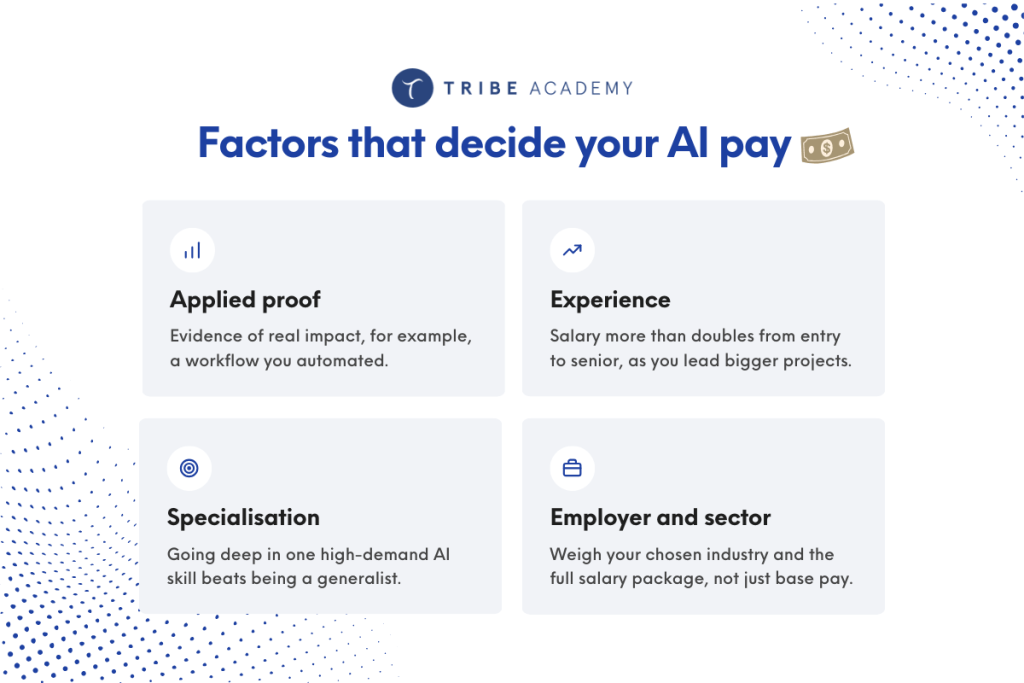
Our recommendation is to work these in order. Start with applied proof in your current role, since it’s quickest to show: use AI where you work now and measure the time and money it saves. From there, specialise in one high-demand area and take on wider scope to build experience, and weigh employer offers on total package, not base pay.
That leaves one question: how to build these skills around a full-time job, which the next section covers.
How to grow your AI skills and salary
The premium goes to people who can turn AI into real output, so build in that direction. Here’s the path we recommend:
Start with applied tools
Build AI into the work you already do, rather than studying it in the abstract.
- Pick one task you repeat every week, such as drafting reports, summarising research or analysing spreadsheets, and rebuild it around a tool like ChatGPT, Claude, Copilot or Gemini until it’s faster than your old method.
- Prompt engineering is the core skill. Give the tool clear context, the task and the format you want rather than typing a vague request.
Move from prompting to workflows
The next step up is stringing those prompts into an automated workflow that handles the repetitive work for you.
- A marketer might link research, drafting and scheduling into one flow that turns a half-day job into minutes, while an operations lead might set up an agent that sorts incoming enquiries and drafts replies.
- Tools like Zapier, Make and n8n let you build these without heavy coding, and the time they save is easy to measure at review time.
Get proper AI training and certification
Structured training gives you a credential employers recognise and a finished portfolio to show, and it keeps you accountable to completing the work.
- AI training ranges from short courses of around 16 to 24 hours, to certificate programmes running several weeks or months, to longer diplomas for those switching into technical roles.
- Most courses qualify for government funding, with Skills and Workforce Development Agency (SWDA) subsidies covering up to 70% of fees, and up to 90% for SMEs. You can offset the rest with your SkillsFuture Credit, since every Singaporean aged 25 and above holds a base credit, plus a $4,000 Mid-Career Credit at 40 and above, bringing many courses down to a small out-of-pocket cost.
- Look for courses built around hands-on projects in your field, so you finish with work you can actually use and point to.
Specialise where pay climbs fastest
Once you’re comfortable applying AI to small individual tasks, go deeper in the area that pays the steepest premium.
- Learn to build retrieval systems that answer questions from your company’s own documents, develop a model for a niche task, or design agents that handle a full workflow in your industry.
- Use that depth to redesign your team’s workflow, or to build a new service or product that wasn’t possible before AI.
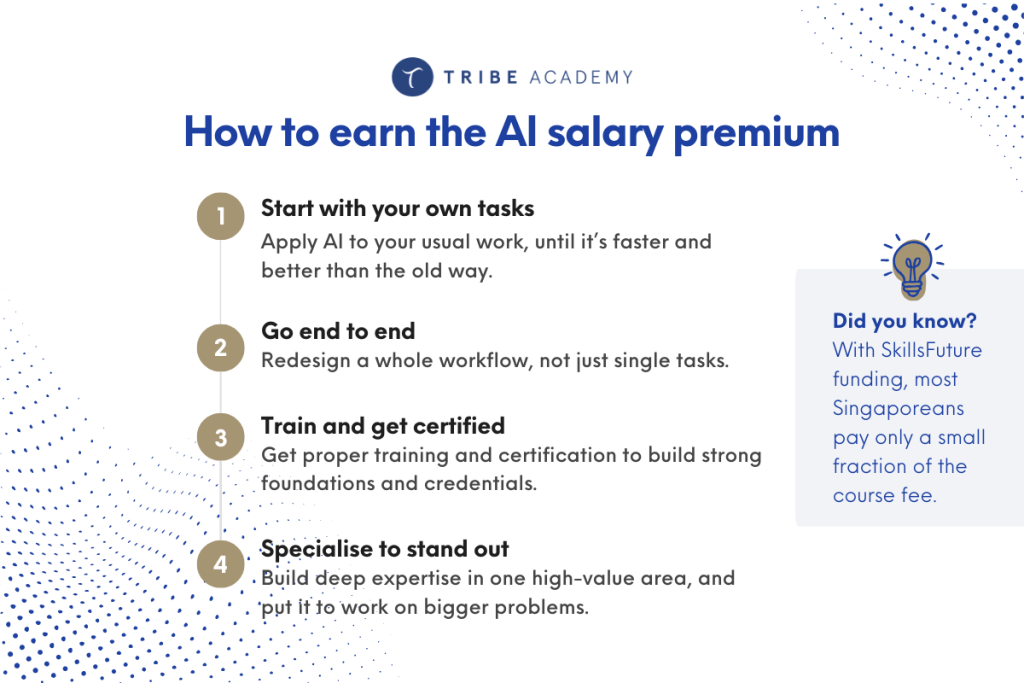
Whether you’re new to the workforce or well into your career, short and practical training aimed at your current role works better than a full degree, since it takes less time, it’s funded through SkillsFuture, and you can apply what you learn at work within the same week.
Your next step in the AI journey
If your aim is to gain practical AI skills for your current jobs or businesses, Tribe Academy offers two SWDA-funded courses that can help you apply AI in your current role from day one. These courses are taught by practitioners rather than theorists, built around hands-on projects you can use at work straight away, and backed by an SMU Academy certificate and career progression support.
📢 For marketers
The SMU Academy (SCTP) Advanced Certificate in Generative AI for Digital Marketing Specialist. A 3-month hybrid programme for professionals who want to apply AI across their marketing work:
- Covers SEO, content, social, email and analytics, then shows you how to amplify each with AI
- Hands-on with tools like ChatGPT, Claude, Midjourney and Canva, plus over 100 ready-made templates to take home
- Build a capstone portfolio of AI-driven campaigns, with no prior experience needed
- Up to 95% SWDA funding, the $4,000 Mid-Career Credit and a $300 monthly training allowance
- Career support and an SMU Academy certificate upon completion
👨🏻💻 For business owners and teams
The SMU Academy (SCTP) Advanced Certificate in Generative AI for Business Growth and Innovation. A 3-month hybrid programme built around three pillars: think, process and communicate:
- Teaches prompt engineering, AI data analysis and workflow optimisation for everyday business work
- Goes further than most into agentic AI, so by Module 3 you’re designing multi-step automations
- Hands-on with tools like ChatGPT, Claude, n8n, Make and Zapier
- Up to 95% SWDA funding, the $4,000 Mid-Career Credit and a $300 monthly training allowance
- Capstone portfolio, career support and an SMU Academy certificate upon completion
Most learners offset the bulk of the fee with SkillsFuture Credit and subsidy, so out-of-pocket cost is often minimal. See how this works in our course preview above, or speak to a course advisor about funding and your eligibility.
Frequently Asked Questions
What is the average AI job salary in Singapore?
Most AI roles pay well above the national median. Applied business roles run from around S$75,000 to S$150,000, data scientists sit at roughly S$96,000 to S$161,000 in total compensation, and senior specialists and leaders can reach S$200,000 to S$350,000.
Do I need to be an engineer to earn an AI salary?
No. Most AI-related demand is for people who can use AI in everyday work, such as marketers, analysts and operations staff, rather than those who build models. Applied AI skills in your current role are enough to earn the premium.
How do AI salaries in Singapore compare to other tech roles?
AI and machine learning roles sit at the top of the tech pay range. A software engineer in Singapore averages about S$114,000 in total compensation, while data and AI roles commonly run higher, and AI or machine learning specialists typically earn 15% to 30% more than generalist engineers at the same level.
Where can I find AI jobs in Singapore?
AI roles are advertised on MyCareersFuture, LinkedIn, and the career pages of banks, regional tech firms such as Grab and Sea, and AI labs. Specialist recruiters like Morgan McKinley and Robert Walters also publish live AI and data openings alongside their salary benchmarks.
How can I start building AI skills?
Start by using AI tools on tasks you already do, then move into workflows and automation. Short, funded courses through SWDA are the fastest structured route for most working professionals, and you can apply what you learn at work straight away.


